• Home
  • Clinical Evidence
    • Key Studies
    • ClotHound Testing
    • DogLeg 24F Testing
    • Radial Force Testing
    • Gravity Filtration
    • Blood Filtration
  • Governance
    • Management Team
    • Board of Directors
  • More
    • Home
    • Clinical Evidence
      • Key Studies
      • ClotHound Testing
      • DogLeg 24F Testing
      • Radial Force Testing
      • Gravity Filtration
      • Blood Filtration
    • Governance
      • Management Team
      • Board of Directors
  • Home
  • Clinical Evidence
    • Key Studies
    • ClotHound Testing
    • DogLeg 24F Testing
    • Radial Force Testing
    • Gravity Filtration
    • Blood Filtration
  • Governance
    • Management Team
    • Board of Directors
CLINICAL EVIDENCE. STUDY SUMMARY

ClotHound testing in a live porcine model

Repeated use of ClotHound in pig veins and arteries showed no significant damage to the vessel lining, even with the spheres opened 20-40% wider than the vessel.

Key Results

20-40%

Clot cleared

5 cycles

Spheres expanded beyond the native vessel diameter, with no significant harm to the tested arteries and veins.

5 cycles

Clot cleared

5 cycles

Five back-and-forth passes left the vessel walls intact on histology.

Clot cleared

Clot cleared

Clot cleared

In the lung-artery model: complete removal in the first pig; in the second, about 80% on the first pass and the rest on a second pass.

What We Tested

Is ClotHound gentle on vessel walls?

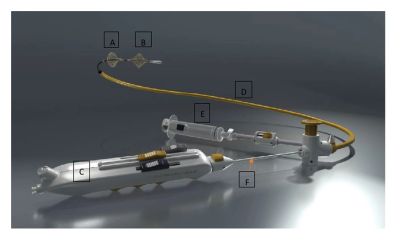
ClotHound uses two manually expandable spheres that open 3 to 16 mm, independently of each other.  The near sphere can slide 5cm back-and-forth along the shaft to loosen clot, and the far sphere is fixed to provide embolic protection downstream.


The study asked whether opening and moving these spheres injures the inner lining (intima) of arteries and veins.  It tested the first-generation device and the second-generation, design-freeze device.
How We Tested It

Two studies in live porcine models.

  • Study 1 (first-generation device, 2 pigs): spheres opened 40% wider than each vein's measured diameter, then moved back and forth five times over 3-5 cm in the jugular and iliac veins.
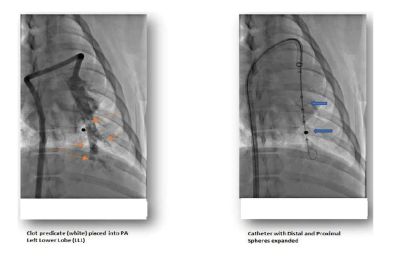
  • Clot removal: a clot was placed in the lung artery (left lower lobe) of two pigs and removed with the device, using a 16F aspiration catheter.
  • Study 2 (second-generation device, 2 pigs): veins and arteries were tested with the spheres at the native vessel diameter and at 20% wider.
  • The vessels were then removed and examined under the microscope (H&E staining bv a veterinary pathologist). The study was done at the University at Buffalo under IRB approval.
What We Found

No significant vessel damage.

Angiograms after the device was used showed no significant damage to the lining

of the veins or arteries. Under the microscope vessel wall integrity was intact and

tissue looked essentially normal with no significant inflammation. Some samples

showed small areas of lost lining that the pathologist described as artifact,

without inflammation or bleeding.


In the lung-artery clot model, the first pig had complete clot removal without

vessel damage. In the second. about 80% of the clot came out on the first pass

and a second pass removed the rest.

READ THE FULL REPORT

The full published paper

Preview the first page below, or download the PDF (4 pages, about 1 MB).

Download the PDF

Other Studies

Dogleg 24F Testing

Radial Force Testing

Radial Force Testing

 The 74F aspiration /guide catheter (7.1 mm ID) tracked through serial 90-180 degree turns, with no lumen collapse at a 6 mm radius of curvature.

Read the Summary

Radial Force Testing

Radial Force Testing

Radial Force Testing

Maximum radial force from the wire sphere was 22 N, far below the force reported to rupture the saphenous vein and pulmonary artery.

Read the Summary

Gravity Filtration

Gravity Filtration

Gravity Filtration

A gravity-fed three-filter system removed 100% of test particles from a blood analogue, at more than 500 cc per minute.

Read the Summary

Blood Filtration

Gravity Filtration

Gravity Filtration

Filtered bovine thrombus left no residual clot, and filtered porcine and human blood showed no sign of red blood cell injury or change in clotting profile.

Read the Summary

Copyright © 2026 Retriever Medical - All Rights Reserved.

Powered by

This website uses cookies.

We use cookies to analyze website traffic and optimize your website experience. By accepting our use of cookies, your data will be aggregated with all other user data.

Accept